

Architecture & People International Conference 2026
Important Dates
- Submission of Abstracts for Papers / Posters – October 25, 2025
- Confirmation of Abstracts for Papers & Posters – November 5, 2025
- Submission of Paper (first draft) – November 30, 2025
- Submission of Poster (first draft) – November 30, 2025
- Review of Papers / Posters – December 15, 2025
- Final submission of Papers & Posters – January 10, 2026
- Declaration Form-– January 10, 2026
Registration Form
Registration form is for conference attendance & paper Publication.
Registration Last Date :- January 12,2026






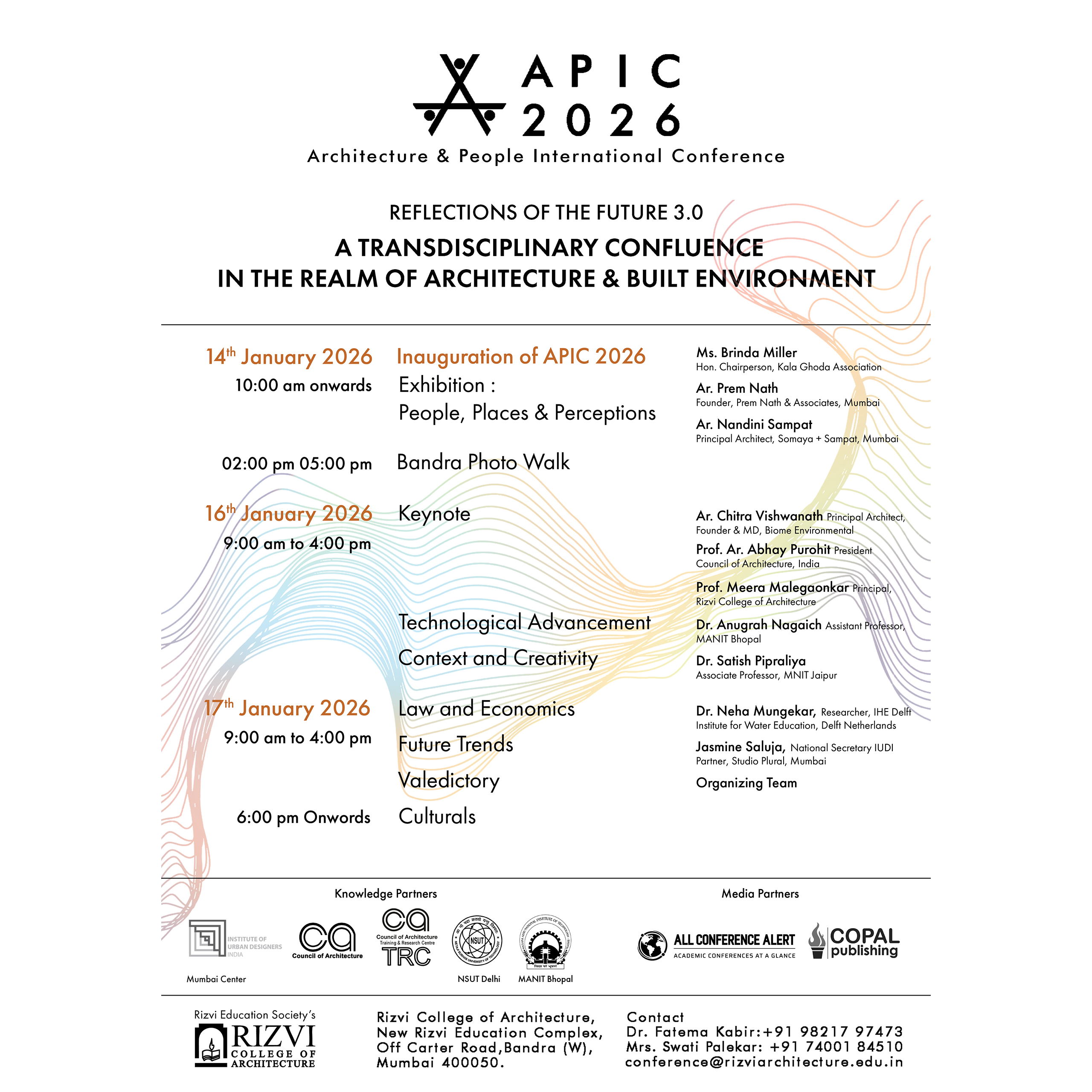
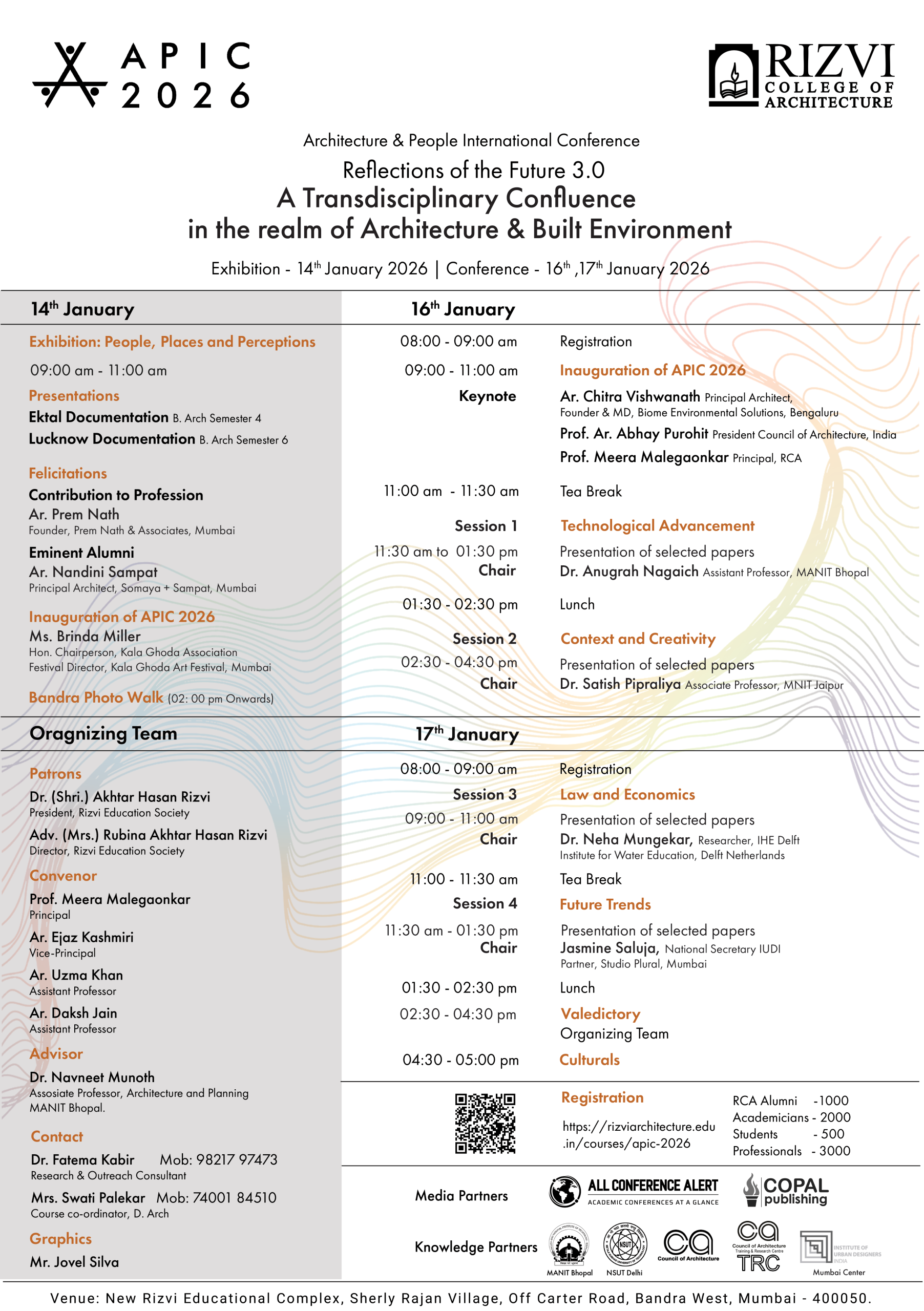
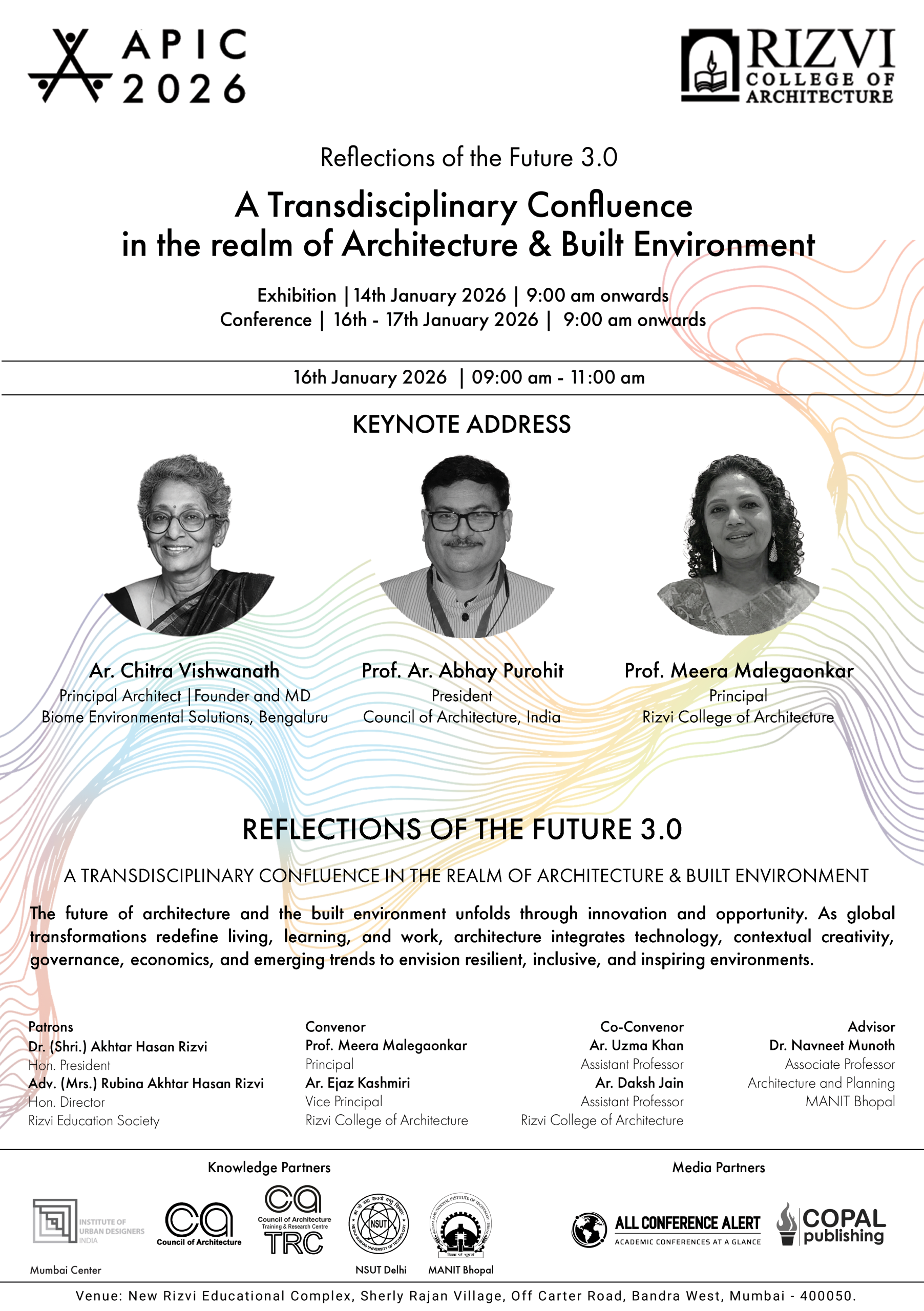
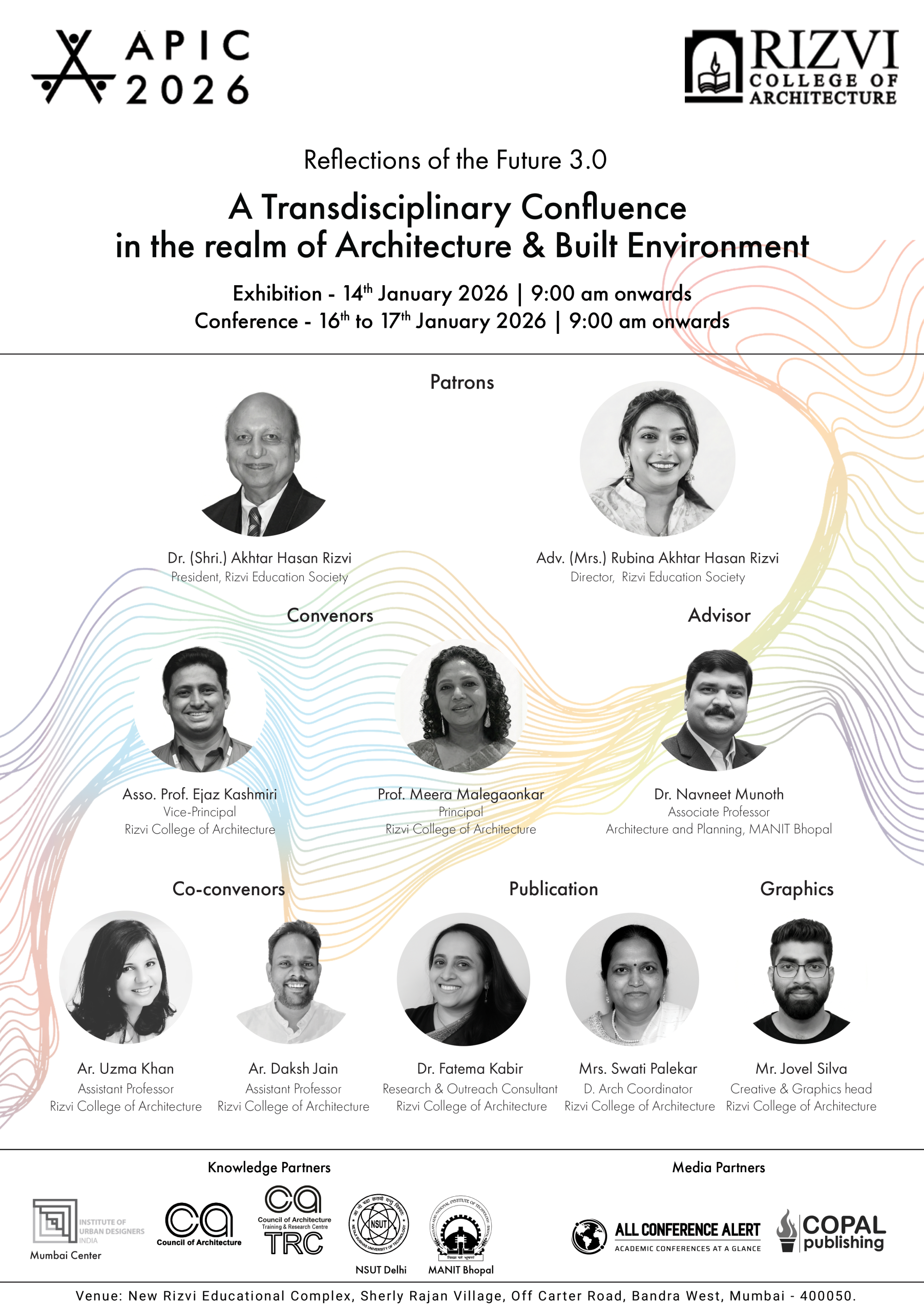
Reflections of the Future 3.0
A Transdisciplinary Confluence in the realm of Architecture & Built Environment
The APIC 2026 positions the practice of Architecture and Urban Studies as an amalgamation of various fields and approaches that integrate knowledge, methods and perspectives across the disciplines. The transdisciplinary confluence in practice blurs the rigid edges and addresses complex problems and provide holistic solutions. Architectural Practice is not a standalone entity and no longer conforms only to technicality or aesthetics. It looks at the inclusion of emerging technologies, cultural and social practices, governance and economics and create a comprehensive framework that resonates with the changing strides. The meta narratives and global shifts have transformed our lifestyles, education and employment; thereby creating intrinsic networked conditions and unpredictability for the future. This requires Architects and Urban Practitioners to navigate, rethink and discuss the issues, opportunities and solutions that transect across multiple disciplines and provide a positive and inclusive future.
The conference discusses four broader pillars of Technological Advancement, Context and Creativity, Law and Economics, and Future Trends within the realm of architectural and urban practices and explore how these pillars intersect to shape resilient, inclusive, and forward-looking environments. Through dialogue and collaboration, APIC envisions architecture as a unifying force that fosters comprehensive, cohesive and inclusive future.
4 Pillars of the Conference
Pillar 1: Technological Advancement
Pillar 2: Context and Creativity
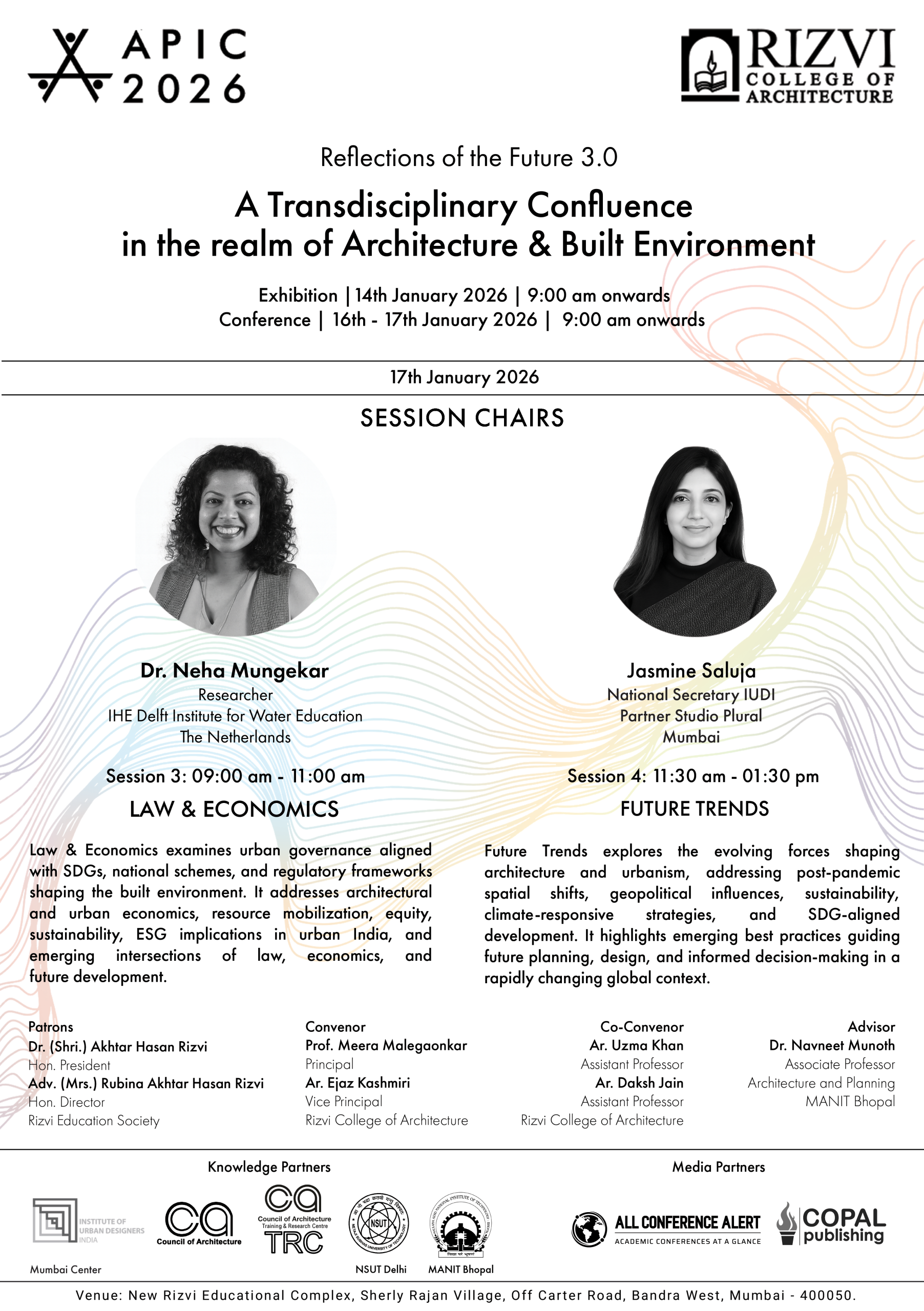
Pillar 3: Law and Economics
Pillar 4: Future Trends
Pillar 1: Technological Advancement
At the Architecture & People International Conference (APIC), under the theme Transdisciplinary Confluence: Reimagining Architecture through the Lens of Interdisciplinary Pathways, the pillar of Technological Advancement explores how innovation is transforming the built environment. This includes the disruptive potential of artificial intelligence, advanced materials, and sustainable construction technologies, as well as immersive AR/VR design tools that are expanding creative possibilities. It also acknowledges the influence of geopolitics and environmental imperatives, where technology serves both as a driver of progress and a strategic response to global challenges. At APIC, this pillar invites dialogue on how technological innovation can enhance resilience, inclusivity, and climate-conscious design, moving beyond efficiency to address deeper societal and ethical responsibilities. By bridging cutting-edge research with practical application, APIC positions technology as a catalyst for reimagining architecture—enabling spaces that are adaptive, forward-looking, and responsive to the evolving needs of people and the planet.
Paper Tracks:
- Artificial Intelligence in Architecture and Urbanism
- Advanced & Smart Materials
- Sustainable and Resilient Construction Technologies
- Immersive Design Technologies (AR/VR/MR/XR) and UI/UX
- Digital Twins and Smart Cities
- Robotics and Automation in Construction
- Digital public infrastructure
- Computational Architecture
- Urban Parametrics
- Digital tools and Sustainable practices
- Data Mining, Visualization and Management
Pillar 2: Context and Creativity
Within the Architecture & People International Conference (APIC) and its theme Transdisciplinary Confluence: Reimagining Architecture through the Lens of Interdisciplinary Pathways, the pillar of Context and Creativity celebrates the intricate relationship between place, culture, and imagination. It examines how theoretical perspectives, cultural evolution, and creative innovations shape architecture that is authentic and human-centered. This includes the integration of diverse art forms, experiential design approaches, and contextual learning that ensures architecture resonates with its users and reflects the identity of its environment. Indian knowledge system is also a critical aspect of context. At APIC, this pillar emphasizes creativity not as an isolated artistic pursuit, but as a socially responsive act—deeply informed by history, geography, and community narratives. By fostering connections between cultural insight and design experimentation, the conference encourages architects to envision spaces that tell meaningful stories, embody shared values, and inspire a sense of belonging, ensuring architecture becomes a medium for dialogue between people and their surroundings.
Paper Tracks
- Cultural Evolution and Identity in the Built Environment
- Indian Knowledge Systems and Indigenous Frameworks
- Creative Digital Innovations in Architecture and Design
- Emerging Practices shaped through Narratives (Journalism, Graphic Design, Filmmaking)
- Art and Architecture Dialogues
- Localized strategies fostering sustainability
- Experiential and Sensory Dimensions of Space – Role of Multimedia
- Community based Solutions and Narratives
Pillar 3: Law and Economics
The Architecture & People International Conference (APIC), themed Transdisciplinary Confluence: Reimagining Architecture through the Lens of Interdisciplinary Pathways, recognizes Law and Economics as an essential pillar in shaping equitable, resilient, and sustainable environments. Architecture operates within complex frameworks of governance, policy, and market dynamics, where regulations, heritage protection, housing rights, and climate-responsive policies play a decisive role. At APIC, this pillar explores how legal and economic systems can be leveraged to promote social justice, protect cultural assets, and ensure accessibility for all. It invites discourse on balancing regulatory compliance with creative freedom, aligning economic feasibility with community benefit, and shaping governance models that support sustainable growth. By examining the intersections of policy, practice, and public interest, APIC positions architects as active participants in advocacy and reform—ensuring that design excellence is matched by ethical responsibility and that architecture serves as a fair, inclusive, and future-ready force in society.
Paper Tracks
- Legal Frameworks and Architecture
- Equity in Governance, Policy, and Planning
- Regulation vs. Creative Freedom
- Future Directions in Law, Economics, and Architecture
- Urban Governance and SDGs
- Urban or Architectural economics and finance approaches
- Resource Mobilization and Management
- ESG and its implications in Urban India
- Urban National Schemes and Policies – Effectiveness and Implementation
Pillar 4: Future Trends
This pillar explores how architecture anticipates and responds to rapidly shifting global realities. Beyond present challenges, this track emphasizes the imaginative projection of possibilities shaped by technological innovation, cultural transformation, environmental urgency, and evolving governance systems. It calls for critical reflection on how architecture can remain adaptive, inclusive, and visionary in the face of uncertainty.
Future Trends also foregrounds speculative thinking, experimental practices, and interdisciplinary provocations—drawing from fields as varied as political science, literature, behavioural economics, and the performing arts. By questioning established norms and learning from unexpected sources, this pillar nurtures radical approaches to placemaking, circulation, policy-making, and social equity. APIC envisions Future Trends as a space of dialogue that not only predicts change but actively designs transformative, resilient, and humane futures.
Paper Tracks
- Post pandemic transformations
- Current Geo-political scenario and responses
- Sustainable approaches
- SDGs and best practices

Bandra Photo Walk Registration Form -– January 13, 2026
updated soon—–